No one arrives at a pool showroom with the thought of pump impeller, scaling a salt cell, or what happens in the long run with the chronically high level of cyanuric acid. They are contemplating the summer. They are envisioning their children in the water, Sunday teas, that specific light on a smooth blue surface at 6 in the evening. It is in the reality of having a pool maintained in that state, week after week of all seasons, that the picture becomes more complex–and that the pool service is less of an option than of an engaging machine that gives reality to the dream. Any pool that does not receive regular professional maintenance is a system that is being run without a feedback mechanism and has all the little troubles piling up silently before they coalesce into something costly and discontinuous.
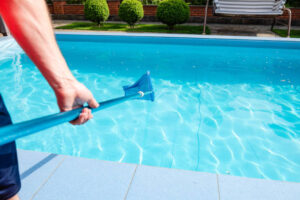
The field which defines the water quality at the bottom level is chemistry management and it is more challenging than seems on the surface by the mere test-and-dose method. Chlorine demand does not follow a fixed pattern, but increases rapidly with the number of bathers in the water, high temperature, and the amount of organic debris present in the water, and decreases when it is cold and few people are in the water, so the constant chlorine dosing schedule always under- or over-treats depending on the week, with the result that the apparent efficacy of the current sanitizer shows an acceptable reading on paper, but the actual efficacy of the available chlorine has been significantly reduced. pH increases naturally due to carbon dioxide off-g Phosphate build-up – the nutrient phosphate in lawn fertilizers, some swimming pool chemicals, and even the water in the area – forms a long-lasting reservoir of nutrient which is exploited by algae even when the chlorine levels are technically sufficient leading to conditions of a bloom that come to the owners completely unannounced. Keeping all these variables in mind, and modifying them in their interrelationships as a unit, is precisely the sort of multi-variable reasoning that distinguishes professional care at its trained stage, when it is performed by trained individuals, and amateur care when it is practiced with hopefulness but in ignorance.
Physical maintenance activities that are most likely to be quietly abandoned by a homeowner include brushing and vacuuming, and algae has a sense of this. Algae spores propagate by settling in dead zones in the circulation of a pool, usually along the edges of steps, the back of ladders, the corners of shallow shelves, etc., before the sanitizer current can practically reach them. Physical disruption can prevent such an attachment process by brushing a weekly, returning the spores to the water column which can then be filtered and treated with chlorine before it forms a bloom. Vacuuming eradicates decaying organic material which would otherwise add up to phosphates and drive up the succeeding algae cycle. The surface debris skimming it does not allow it to sink and contribute to that organic load. The three tasks mutually support one another in an identical cycle that ensures that the load on the chemical system is manageable even at the base – neglect them all, and even good chemistry will begin to falter.
The professional maintenance makes its best tangible financial contribution at equipment longevity. The cost of replacement of pool pumps, heaters, variable-speed drives, automation controllers, and salt chlorination systems is high, and they are all sensitive to the quality of care they get. Baskets that are not emptied create back-pressure and enhance the wearing of bearings. Salt cells covered with a calcium scale yield less chlorine per cycle and using the same amount of energy and decreases its efficiency invisibly until the output declines enough to impact the water quality. The deposits which form in heater heat exchangers reduce thermal transfer and increase the time at which the unit operates at the same temperature which decreases its service life and increases operating costs all at the same time. A regular service man becomes familiar with your particular equipment in the course of time, what it sounds like, how it reads, how it acts in the summer, the spring, the spring, and that familiarity leads to early diagnosis of your failure which prevents small problems from growing into large money outlays.
The greatest pool experiences do not occur by chance. They occur due to the fact that an informed person has been taking note long enough to have everything neatly stored reliably working in the background, and it remains only to climb into the water.